
Palau Macaya
By Michael Mueller
© Jesús Cano Sánchez
Look for the man on a bicycle at the entrance to Palau Macaya. The carving by Eusebi Arnau is said to represent architect Josep Puig i Cadafalch, who pedaled between this building and Casa Amatller while working on both. Beside him, another figure wears a barretina (the traditional Catalan cap). An architect on his daily rounds is a pleasingly ordinary subject for such an ornate house.
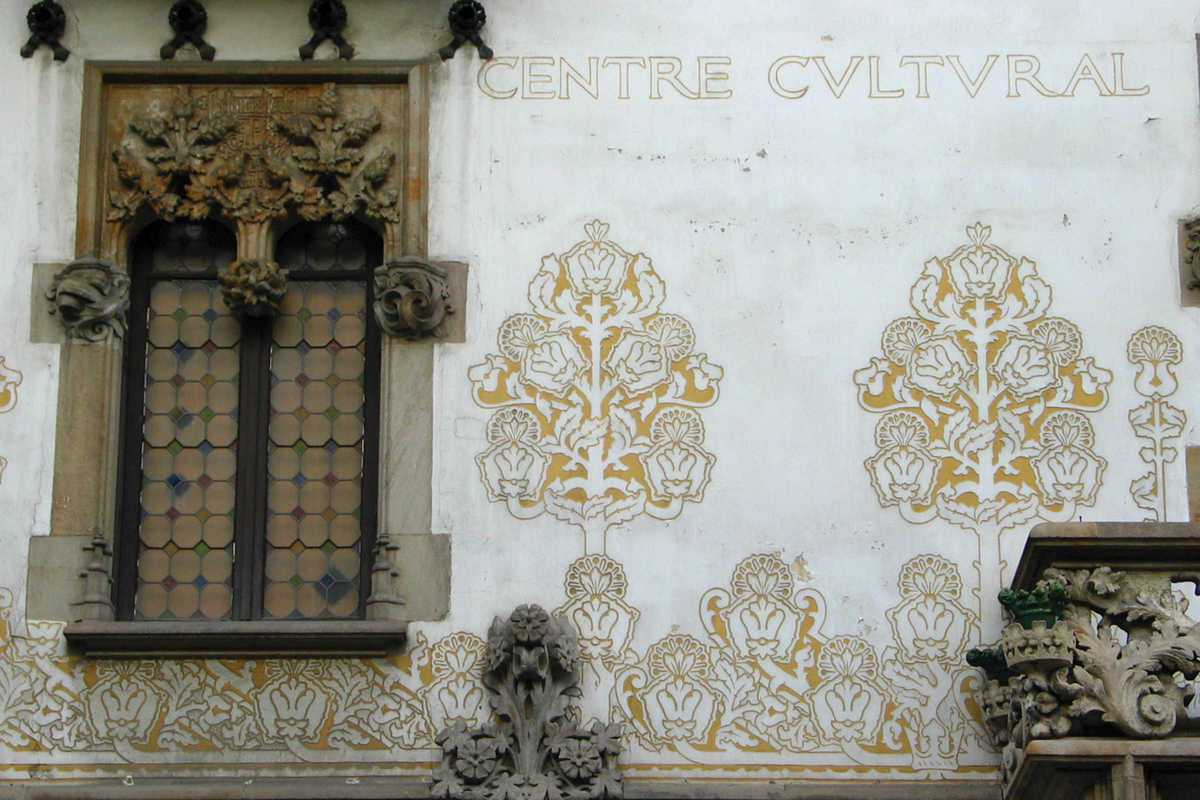
Industrialist Romà Macaya commissioned the house, which was built around 1898–1901. Its white stucco facade stands out on Passeig de Sant Joan, decorated with ochre sgraffito by Joan Paradís and elaborate carved stonework. Inside, a tiled vestibule leads to the central courtyard, where floral carving adorns the stone staircase and a glazed dome brings light from above. Much of the original domestic interior has been lost, but the entrance and courtyard preserve a generous sample of the crafts that went into the house.
“la Caixa” bought the building in 1947 and established a school for deaf and blind students. It later became a cultural center, a forerunner of CaixaForum, and served for a time as a science museum. Today it houses the Social Observatory of the Fundació “la Caixa” and an International Centre for Human and Social Sciences under the auspices of UNESCO, the first of its kind in Spain.
The public program runs to talks, debates and round tables. Housing, loneliness and the future of rural communities are among the questions explored. Talks are free with advance booking; check the program for a subject that interests you. The courtyard is free to visit too. Even without a talk in mind, step through the entrance and look up.